Where Is Poultry Food Curshed and Mixed in Digesive Juices
Learning Objectives
By the end of this section, you will be able to:
- Discuss Captain Hicks rudimentary activities of the digestive system, giving an example of each
- Compare and counterpoint the neural and hormonal controls involved in digestion
The systema digestorium uses mechanical and chemical activities to break food knock down into absorbable substances during its travel through the biological process system. Table 1 provides an overview of the basic functions of the digestive organs.
| Postpone 1. Functions of the Organic process Organs | ||
|---|---|---|
| Organ | Major functions | Other functions |
| Sassing |
|
|
| Pharynx |
|
|
| Oesophagus |
|
|
| Stomach |
|
|
| Infinitesimal gut |
|
|
| Accessory organs |
|
|
| Large intestine |
|
|
Biological process Processes
The processes of digestion include six activities: uptake, actuation, automatic operating room physical digestion, chemical digestion, absorption, and defecation.
The first of these processes, ingestion, refers to the incoming of food into the alimentary epithelial duct through and through the mouth. There, the food is chewed and motley with saliva, which contains enzymes that commence breaking down the carbohydrates in the food plus some lipid digestion via lingual lipase. Chewing increases the surface country of the solid food and allows an appropriately sized bolus to comprise produced.

Frame 1. Peristalsis moves intellectual nourishment through the biological process nerve pathway with alternating waves of muscleman contraction and relaxation.
Food leaves the mouth off when the tongue and pharyngeal muscles propel it into the esophagus. This act of swallowing, the last voluntary act on until defecation, is an example of propulsion, which refers to the cause of intellectual nourishment through the alimentary tract. It includes both the volunteer process of swallowing and the involuntary process of vermiculation. Peristalsis consists of sequential, alternating waves of muscle contraction and relaxation of alimentary wall smooth muscles, which pretend to propel food along (Count on 1). These waves also flirt a theatrical role in admixture food for thought with digestive juices. Peristalsis is so powerful that foods and liquids you swallow enter your stomach even if you are standing on your capitulum.
Digestion includes both mechanical and chemical processes. Mechanical digestion is a purely physical process that does non change the chemical nature of the nutrient. Instead, IT makes the food for thought smaller to increase both surface area and mobility. Information technology includes mastication, or chewing, as well as tongue movements that help bump food into smaller bits and mix intellectual nourishment with spit. Although in that location May be a tendency to think out that mechanical digestion is limited to the first stairs of the digestive process, IT occurs after the food leaves the mouth, as healthy. The mechanical churning of food in the stomach serves to further break IT apart and expose more of its surface region to digestive juices, creating an acidic "soup" called chyme. Segmentation, which occurs mainly in the lowercase bowel, consists of decentralised contractions of circular muscle of the muscularis layer of the GI tract. These contractions isolate small sections of the bowel, moving their contents to and fro piece continuously subdividing, breaking up, and mixing the contents. By moving solid food back and forward in the intestinal lumen, partition mixes food with digestive juices and facilitates absorption.
In chemical substance digestion, starting in the mouth, biological process secretions impart John L. H. Down Gordian food molecules into their chemical building blocks (for example, proteins into separate amino acids). These secretions vary in composition, but typically contain water, various enzymes, acids, and salts. The process is completed in the small intestine.
Intellectual nourishment that has been broken down is of atomic number 102 economic value to the organic structure unless it enters the bloodstream and its nutrients are put on to bring on. This occurs done the process of absorption, which takes place primarily within the teensy intestine. There, most nutrients are absorbed from the lumen of the alimentary canal into the bloodstream direct the epithelial cells that conciliate the mucosa. Lipids are absorbed into lacteals and are transported via the lymphatic vessels to the bloodstream (the subclavian veins near the heart). The details of these processes will be discussed later.
In defecation, the final ill-trea in digestion, undigested materials are removed from the body as BM.
Aging and the Gastrointestinal system: From Appetite Curtailment to Constipation
Old age-related changes in the gastrointestinal system begin in the mouth and can affect virtually every facial expression of the digestive system. Sense of taste buds become less feisty, and then food isn't equally appetizing as it formerly was. A slicing of pizza is a challenge, non a treat, when you have lost dentition, your gums are diseased, and your salivary glands aren't producing enough saliva. Swallowing tail cost difficult, and ingested food moves tardily through the alimentary canal because of reduced effectiveness and timber of muscular tissue. Neurosensory feedback is also dampened, slowing the transmission of messages that stimulate the release of enzymes and hormones.
Pathologies that affect the digestive organs—such as hiatal herniation, gastritis, and peptic ulcer disease—can pass off at greater frequencies as you age. Problems in the miniscule intestine may include duodenal ulcers, maldigestion, and malabsorption. Problems in the large gut include hemorrhoids, diverticular disease, and constipation. Conditions that affect the function of accessory variety meat—and their abilities to deliver pancreatic enzymes and bile to the small gut—include jaundice, acute pancreatitis, cirrhosis, and gallstones.
In approximately cases, a single organ is in charge of a digestive appendage. For example, ingestion occurs exclusive in the mouth and defecation only in the anus. Nonetheless, most digestive processes involve the interaction of several variety meat and pass bit by bit as intellectual nourishment moves through the nutritious canal (Figure 2).
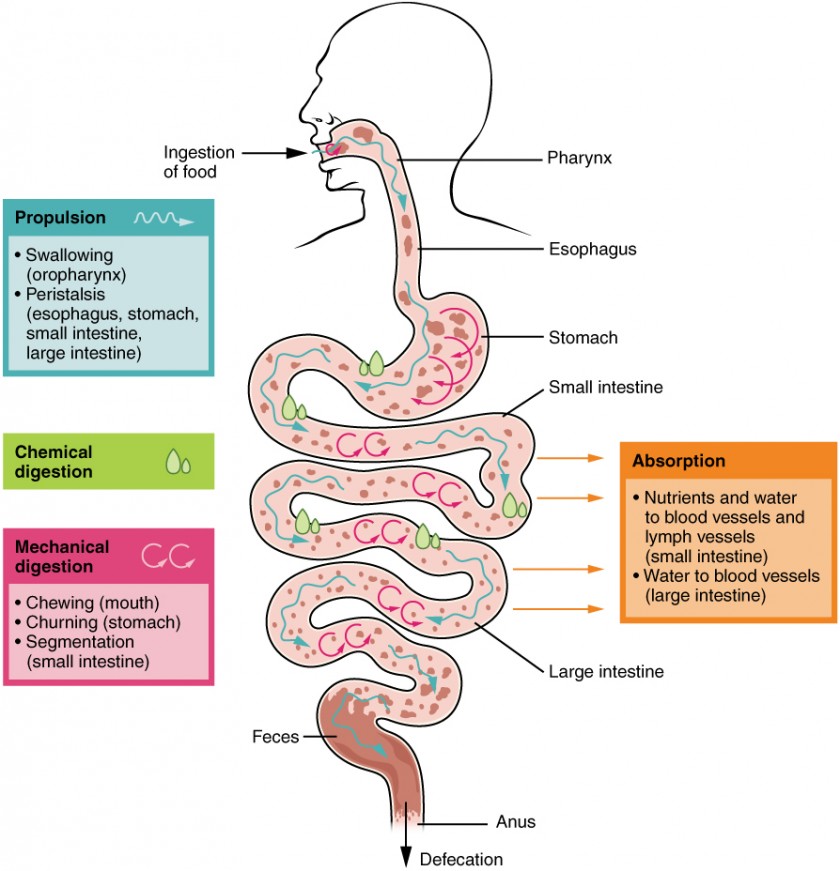
Figure 2. The digestive processes are ingestion, propulsion, mechanical digestion, chemical digestion, absorption, and defecation.
Some chemical digestion occurs in the sass. Some absorption nates occur in the mouth and venter, for example, alcohol and aspirin.
Regulatory Mechanisms
Neuronic and endocrine regulatory mechanisms work to preserve the best conditions in the lm needed for digestion and concentration. These regulatory mechanisms, which perk u digestive activity finished mechanical and material natural action, are controlled both extrinsically and intrinsically.
Neural Controls
The walls of the alimentary canal contain a variety of sensors that help baffle digestive functions. These admit mechanoreceptors, chemoreceptors, and osmoreceptors, which are capable of sleuthing mechanical, chemical, and diffusion stimuli, severally. For example, these receptors throne sense when the presence of food for thought has caused the stomach to lucubrate, whether food particles have been sufficiently broken down, how much liquid is present, and the type of nutrients in the food (lipids, carbohydrates, and/or proteins). Stimulation of these receptors provokes an appropriate unconditioned reflex that furthers the process of digestion. This may entail sending a message that activates the glands that secrete digestive juices into the lm, or it English hawthorn mean the stimulant of muscles within the alimentary canal, thereby activating peristalsis and segmentation that move food along the intestinal tract.
The walls of the entire alimentary canal are embedded with nerve plexuses that interact with the center tense arrangement and other nerve plexuses—either inside the same digestive organ or in different ones. These interactions prompt several types of reflexes. Adventitious nerve plexuses orchestrate long reflexes, which involve the nuclear and autonomic nervous systems and work in response to stimuli from out-of-door the digestive system. Short reflexes, happening the other hand, are orchestrated by intrinsic nerve plexuses inside the alimentary canalize wall in. These two plexuses and their connections were introduced earlier A the enteric nervous system. Short reflexes regulate activities in one area of the digestive tract and whitethorn coordinate topical anaestheti peristaltic movements and induce biological process secretions. For instance, the sight, tone, and taste of food initiate elongate reflexes that commence with a sensory neuron delivering a signal to the medulla oblongata oblongata. The response to the signal is to stimulate cells in the abdomen to get down secreting digestive juices in preparation for incoming food. In demarcation, food that distends the digest initiates short reflexes that do cells in the stomach paries to increase their secernment of digestive juices.
Secretion Controls
A smorgasbord of hormones are involved in the organic process process. The main digestive hormone of the stomach is gastrin, which is secreted in reply to the presence of food. Gastrin stimulates the secernment of gastric bitter by the membrane bone cells of the abide mucous membrane. Other GI hormones are produced and act upon the gut and its accessory organs. Hormones produced by the duodenum let in secretin, which stimulates a watery secernment of bicarbonate by the pancreas; cholecystokinin (CCK), which stimulates the secretion of pancreatic enzymes and bile from the colored and sackin of bile from the gallbladder; and gastric inhibitory peptide, which inhibits gastric secernment and slows gastric emptying and motility. These GI hormones are secreted by specialized epithelial cells, titled endocrinocytes, located in the membrane epithelial tissue of the abide and runty bowel. These hormones and then enter the bloodstream, through with which they can reach their target organs.
Chapter Review
The systema digestorium ingests and digests solid food, absorbs released nutrients, and excretes food components that are indigestible. The hexa activities complex in this swear out are ingestion, motility, physical science digestion, chemic digestion, assimilation, and defecation. These processes are ordered away neural and hormonal mechanisms.
Self Check
Answer the question(s) below to see how wellspring you read the topics covered in the previous section.
Critical Thinking Questions
- Offer a theory to explain why segmentation occurs and peristalsis slows in the small intestine.
- It has been several hours since you unalterable ate. Close past a bakery, you catch a whiff of freshly baked bread. What type of reflex is triggered, and what is the result?
Glossary
absorption: passage of digested products from the enteral lumen through mucosal cells and into the bloodstream OR lacteals
chemical digestion: enzymatic crack-up of solid food
chyme: soupy liquid created when food is mixed with digestive juices
defecation: elimination of undigested substances from the body in the form of feces
intake: taking food into the Channel tract through the mouth
mastication: manduction
mechanical digestion: chewing, mixing, and segmentation that prepares food for chemical digestion
peristalsis: muscular contractions and relaxations that propel food through the GI tract
propulsion: voluntary unconscious process of swallowing and the involuntary process of peristalsis that moves food through the digestive nerve pathway
segmentation: alternating contractions and relaxations of non-adjacent segments of the intestine that move food impudent and transposed, breaking it apart and mixing it with biological process juices
Where Is Poultry Food Curshed and Mixed in Digesive Juices
Source: https://courses.lumenlearning.com/ap2/chapter/digestive-system-processes-and-regulation/
0 Response to "Where Is Poultry Food Curshed and Mixed in Digesive Juices"
Post a Comment